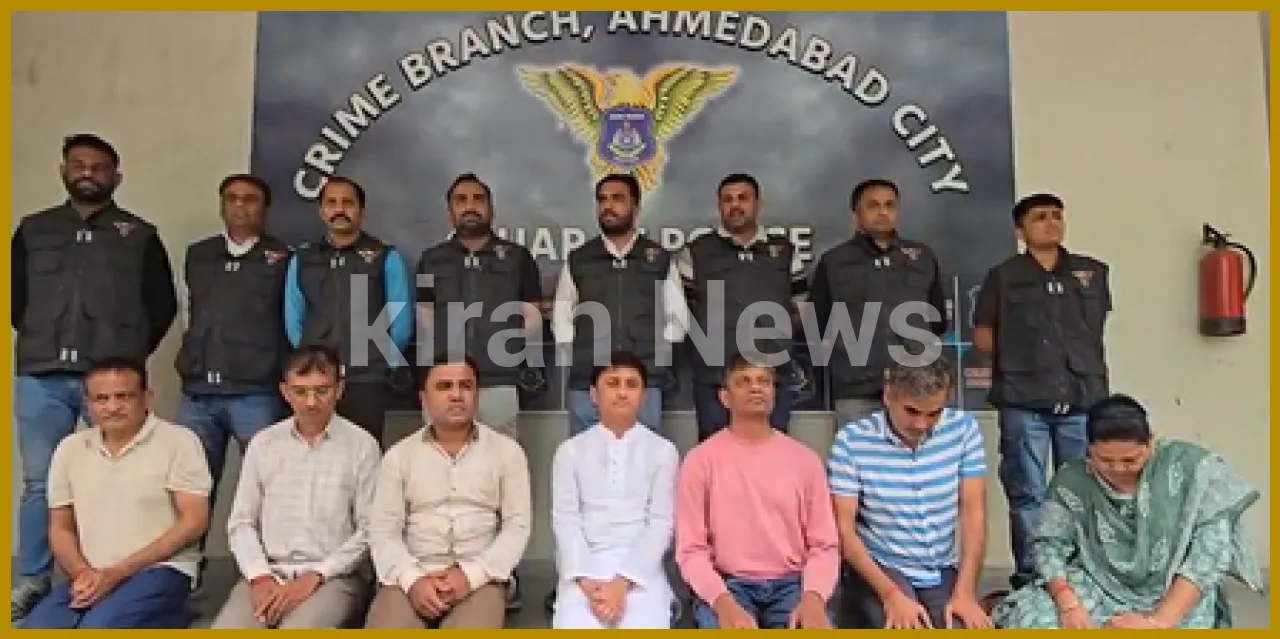
Ahmedabad, March 19: The Ahmedabad Crime Branch has achieved a significant breakthrough in uncovering a fake currency racket, leading to the arrest of seven individuals, including a woman involved in the production and circulation of counterfeit Indian notes. This operation has effectively prevented substantial damage to the national economy.
Based on intelligence reports, the Crime Branch intercepted a white Fortuner vehicle (GJ-05-RS-5252) en route from Surat to the Amraiwadi area of Ahmedabad, carrying fake ₹500 notes for delivery. The vehicle was stopped near Torrent Power in Amraiwadi, where police discovered bundles of counterfeit currency hidden in a black bag during a search. All individuals in the vehicle were taken into custody.
During the investigation, it was revealed that the accused had been plotting to print fake currency at a residential location in Surat for the past four months. The operation was led by Mukeshbhai Lakhabhai Thummar, who had arranged for the necessary infrastructure, including printers and paper-cutting machines. The gang sourced security thread paper marked with the Reserve Bank of India (RBI) and India’s insignia from Chinese suppliers using digital payment gateways and online platforms like Alibaba.
Furthermore, the investigation uncovered that digital tools, including photo-editing software and AI-based platforms like ChatGPT, were employed to replicate the design, layout, and features of genuine Indian currency. One of the accused possessed expertise in graphic editing and printing processes, which he utilized to enhance the quality of the counterfeit notes.
Acting on the intelligence received, a team from the Crime Branch was dispatched to Surat, where they coordinated with the Surat crime Branch to secure the location where the fake currency was being produced. The counterfeit notes were being printed at the ‘Shri Satya Yog Foundation’ ashram located in Dhoran Pardi village of Kamrej taluka in Surat district. The ashram’s guru, revered Aashtang Yog Siddh Sadguru Pradeep, was also arrested for his involvement in the operation.
The Crime Branch raided the ashram, seizing numerous documents and equipment used in the printing of counterfeit currency. Approximately ₹2.10 crore worth of fake ₹500 notes (42,000 notes), the Fortuner vehicle valued at around ₹25 lakh, mobile phones, and cash amounting to approximately ₹1.20 lakh were recovered from the gang’s vehicle in Ahmedabad. Additionally, around ₹28 lakh worth of fake ₹500 notes, security thread paper (16 reams), printers, laptops, paper-cutting machines, note-counting machines, and other equipment were seized from the Surat hideout.
All arrested individuals are residents of Surat, identified as Mukeshbhai Lakhabhai Thummar, Ashokbhai Dhanjibhai Mavani, Rameshbhai Vallabhbhai Bhalar, Divyesh Ishwarbhai Rana, Pradeepbhai Dilipbhai Jotangia, a female accused from Kataragam, and Bharatbhai Valjibhai Kakadiya. They have all been arrested, and a case has been registered at the DCB police station. The police are continuing their investigation to uncover a broader network, financial transactions, and potential interstate or international connections.
This operation has a critical impact on the security of the country’s financial system. The circulation of high-quality counterfeit currency directly undermines public trust in legitimate currency, disrupts monetary stability, and can be used to finance organized crime and other illegal activities. The seizure of such a large quantity of counterfeit currency, along with the dismantling of an organized printing unit, effectively neutralizes a supply chain that could have flooded the market with fake notes.
By halting the distribution phase and identifying the source of production, the Crime Branch has not only prevented immediate economic damage but also curtailed a large network that could have expanded its operations. This case highlights the evolving methods of crime, involving international supply chains and digital tools, reinforcing the need for continuous vigilance and technological adaptation among law enforcement agencies.