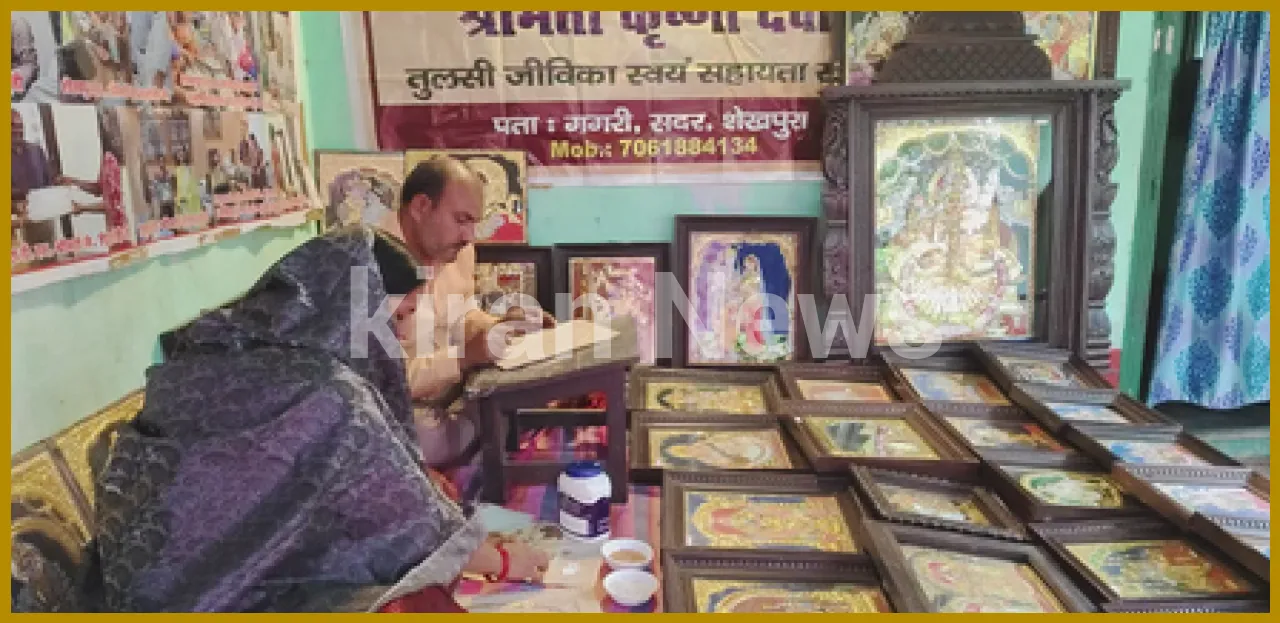
Shekhpura, 29 January: Emerging from the small village of Gunhesa in Gagri Panchayat, Shekhpura district of Bihar, Krishna Devi has carved a distinct identity in the country’s traditional art scene. Despite limited resources, minimal education, and social challenges, she has demonstrated that determined efforts and patience can overcome all obstacles.
Joining as a Jeevika Didi, Krishna Devi not only achieved economic independence but also brought new recognition to the delicate and traditional Tanjore Painting art in Bihar. In a special conversation, she shared that she received formal training in Tanjore painting in Chennai, where her husband had been residing earlier.

She explained that the Tanjore painting process demands great patience and hard work. It begins with a plywood board covered with cloth, on which a raised image of a deity is created using lime, glue, and other mixtures. This is then painted and overlaid with a 22-carat gold foil. Completing one painting typically takes about 15 days, and larger paintings may require even more time.
Krishna Devi has exhibited her art in several states, with good sales of her deity images in major cities like Delhi. So far, her business turnover from Bihar has reached around four lakh rupees. She receives information about various exhibitions through official letters, with arrangements made for travel and accommodation.
Praveen Kumar, a Tanjore painting artist, noted that his wife Krishna Devi has been associated with Jeevika since 2016. At that time, he was working as a labourer in Chennai. Due to the COVID-19 pandemic in 2020, they lost employment in Tamil Nadu and returned to Bihar out of necessity. Subsequently, they approached the Jeevika office, where their art was appreciated. Through Jeevika, they got opportunities to participate in fairs and exhibitions and also availed loans easily, helping them expand their business.
Praveen Kumar added that initially, people mocked their art, but now the same people admire their work. Krishna Devi was also honoured by the ministry at Noida Haat. He emphasised that without Jeevika’s support, none of this would have been possible. With assistance from Jeevika and the Industry Department, their income has significantly improved.

The most distinctive feature of Tanjore painting is the use of 22-carat gold foil, which not only enhances its beauty but also increases its value and importance. This intricate art demands time and tests the patience of the artist. Krishna Devi, together with her husband, has vowed to keep this traditional South Indian art form alive in Bihar. Although she faced many difficulties initially, including the unavailability of raw materials locally, requiring trips to Tamil Nadu, she never gave up.
Recognition through government fairs and programs changed the course of Krishna Devi’s life. With Jeevika’s help, she got chances to set up stalls at major fairs and exhibitions held in cities such as Patna’s Gandhi Maidan, Bhubaneswar, Indore, Gurugram, and Haryana. Gradually, people’s interest in this unique art grew, and demand for Tanjore paintings increased. Today, her paintings are appreciated not only in Bihar but also across other states, with sales reaching lakhs of rupees.

Krishna Devi’s paintings prominently feature images of deities like Krishna, Ram, Vishnu, Lakshmi, and Shiva. Using wooden boards, raised figures are created with lime, glue, and clay, then filled with deep and attractive colours such as red, green, blue, and gold. Her success story is a testament to how proper guidance, government support, and self-confidence enable rural women to create their identity through traditional art, becoming economically empowered and setting an example of social change.