(Patrika English News): The “metaverse” may conjure images of futuristic games and digital avatars, but across the United States it is emerging as a serious educational tool. Mathematics — often viewed as abstract and intimidating — is being reimagined in virtual reality (VR) environments that turn lessons into immersive, hands-on experiences.
Math in 3D: From Georgia Classrooms to MIT Labs
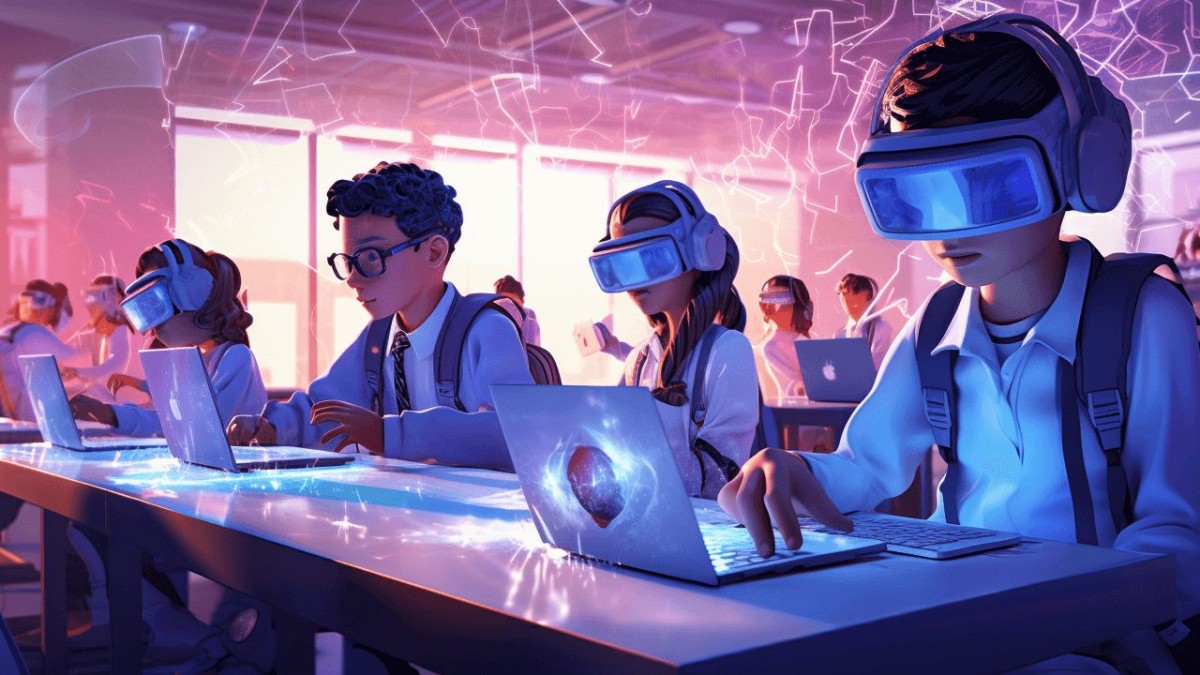
In Georgia’s Cobb County, middle and high school teachers are using VR headsets and the Prisms of Reality platform to teach geometry and algebra through interactive 3D scenarios. Instead of solving formulas on paper alone, students step into math problems — manipulating shapes, measuring dimensions, and navigating virtual spaces. Teachers say concepts that once took months to master are now being learned in weeks.

Research backs up these results. MIT News reported in 2024 that spatial learning through VR can make abstract math and science concepts far more intuitive, potentially becoming “the next textbook.”
Faster Learning, Stronger Recall
Platforms like PrismsVR rely on “embodied learning,” where students physically interact with problems in 3D space. According to IEEE Spectrum, topics that normally required three to four weeks of instruction were mastered in just one week when taught with VR.

The benefits extend beyond K–12. At Morehouse College in Atlanta, VR-enhanced learning reportedly boosted average test scores from 78 (in-person) to 85, while improving attendance and engagement, according to Meta’s education initiative.
Virtual Field Trips: Math in Context
Beyond classrooms, VR is opening doors to immersive field trips. Platforms like Kai XR let elementary students explore world heritage sites such as Chichen Itza, discovering geometry in ancient architecture and astronomy in Mayan design. By connecting math to real-world history and culture, VR makes abstract numbers feel relevant and alive.

A Global Shift in Education
A Brookings Institute report noted that metaverse-based education goes beyond traditional subject silos. Math can be seamlessly integrated with literacy, science, history, and collaborative problem-solving in shared virtual environments.
The Future of Learning
From faster mastery of algebra to interactive geometry field trips, US schools are proving that the metaverse is more than a buzzword. Early evidence shows VR makes math more intuitive, engaging, and effective, helping students not only learn faster but also appreciate math as a living, interactive subject rather than a dry, abstract one.